
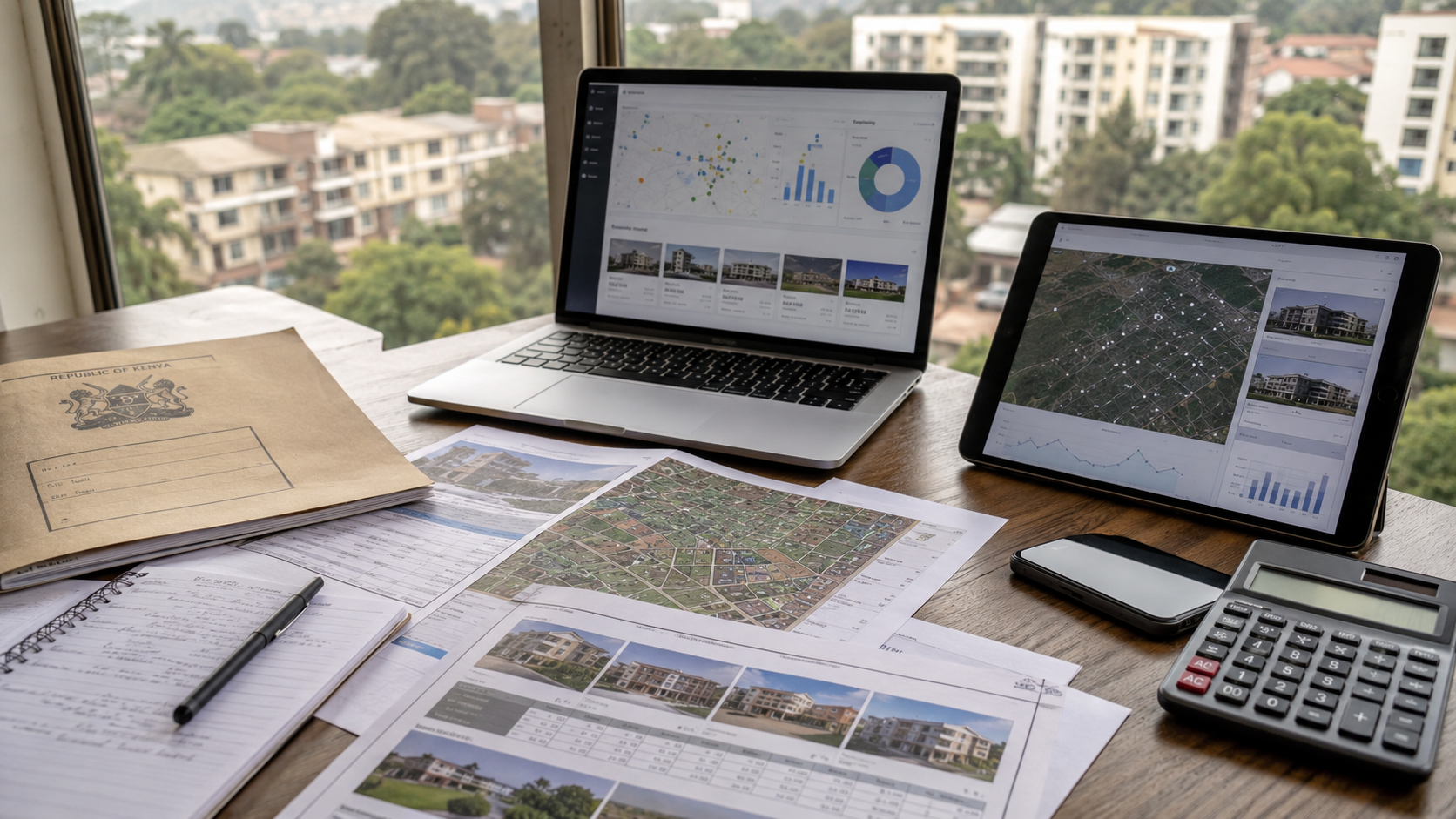
Why People Ask “How Much Is My Property Worth?”
A two-bedroom apartment in Kilimani can sell for KSh 8 million or KSh 18 million. The difference is rarely luck. It is property valuation.
A half acre in Karen can be ordinary on one road and extremely valuable two turns away. A house in Runda can look similar to another house online, but the land size, estate, access, security, water and proximity to Gigiri can push the value in a completely different direction. A plot in Syokimau, Ruaka, Kitengela or Ngong can change value because of access roads, demand, zoning, drainage, utilities or nearby development.
This is why property valuation Kenya is such an important subject.
People ask “How much is my property worth?” for different reasons. A seller wants to avoid underpricing. A buyer wants to avoid overpaying. A bank wants to know whether a property can support a loan. An investor wants to understand return. A family may need value for inheritance, divorce, probate, insurance or planning. A landlord may want to know whether to sell, refinance or hold.
House valuation Kenya, land valuation Kenya and property estimate Kenya all come back to the same question:
What would this property reasonably sell for in the current market?
That question sounds simple. It is not.
Property value is shaped by location, land size, property type, condition, access, services, title, demand, comparable sales, rental potential, infrastructure, buyer sentiment and timing. It is also shaped by what similar properties have recently sold or been listed for in the same area.
That is where valuation begins.
Not with hope.
Not with rumours.
Not with “my neighbour sold for this.”
With evidence.
What Property Valuation Actually Means
Property valuation is the process of estimating the value of a property at a specific point in time.
That last part matters.
A valuation is not permanent. A property can be worth one figure today and a different figure two years from now. A road can be improved. A school can open nearby. A new mall can change demand. A neighbourhood can become overbuilt. Interest rates can rise. Buyers can become cautious. Rents can move. Land can become scarce. Zoning can change.
A valuation is an informed view of value based on available evidence.
It is not a wish.
It is not the owner’s emotional price.
It is not automatically the asking price.
It is not always the bank’s forced sale figure.
It is not always what a developer hopes to pay.
It is the most reasonable estimate of value given the property, market and purpose of the valuation.
Market Value
Market value is the price a willing buyer and willing seller would reasonably agree on, assuming both understand the property and neither is being forced.
This is the value most people mean when they ask, “What is my property worth?”
Forced Sale Value
Forced sale value is usually lower than market value. It reflects what a property might fetch if it had to be sold quickly, often under pressure.
Banks care about this because if a borrower defaults, the bank needs to know what the property might recover under a quicker sale.
Investment Value
Investment value depends on the buyer’s strategy.
A landlord may value an apartment based on rent. A developer may value land based on what can be built. A family may value a home based on schools and comfort. An investor may pay more or less depending on expected returns.
Insurance Value
Insurance value is about replacement or reinstatement, not necessarily market sale price.
A house may sit on land worth KSh 120 million, but the building may cost far less to replace. Insurance often focuses on the cost of rebuilding the structure, not buying the land again.
Replacement Cost
Replacement cost asks: what would it cost to build this again today?
It considers construction cost, materials, labour, professional fees and sometimes depreciation.
Book Value
Book value is an accounting concept. It may appear in company books, but it is not always the same as market value.
That is why one property can have different values depending on the purpose.
Valuation is not one number for all situations. It is a number tied to a question.
Why Property Valuation Matters
Property valuation matters because real estate decisions are expensive mistakes when made blindly.
Selling Property
A seller who underprices loses money immediately.
A seller who overprices may sit in the market for months, become stale, chase away serious buyers and eventually accept a lower offer than they could have received with better pricing from the start.
Good valuation helps a seller enter the market with confidence.
Buying Property
A buyer needs valuation to avoid paying yesterday’s dream price in today’s market.
A beautiful listing can still be overpriced. A cheap property can still be a trap. Valuation gives the buyer context: what similar properties are asking, what they have sold for, how the subject property compares and whether the price makes sense.
Bank Loans and Mortgages
Banks use valuation to understand security.
If a borrower wants a mortgage or loan, the bank needs to know whether the property can reasonably support that lending. The property is not only a home; it is collateral.
Divorce
In divorce or separation, property value may need to be established for fair division of assets.
This is usually not a place for guesswork. A formal valuation may be needed.
Inheritance and Probate
Families often need valuation when property is being inherited, transferred, sold or distributed.
Without a clear value, disagreements can arise quickly.
Taxation
Property value may matter in tax planning, transfers, stamp duty considerations, capital gains discussions or other legal and financial matters.
A professional advisor should guide formal tax questions, but valuation is often part of the evidence.
Investment Decisions
Investors use valuation to decide whether to buy, hold, rent, renovate, subdivide, develop or sell.
For investors, value is not only what the property is worth today. It is what the property can become.
Insurance
A property owner may need valuation or replacement cost advice to avoid underinsuring or overinsuring a building.
If the insured value is too low, a claim may not fully cover the loss. If it is too high, the owner may pay unnecessary premiums.
Who Performs Property Valuations in Kenya?
Formal property valuations in Kenya are done by professional valuers.
A professional valuer is trained to inspect property, analyse evidence, apply valuation methods and prepare a valuation report. Formal valuation work is different from an agent’s opinion or a seller’s asking price.
In Kenya, formal valuation may involve:
- registered valuers
- valuation firms
- bank panel valuers
- government valuers
A bank may instruct a valuer before approving a loan. A court may require formal valuation evidence. A family may appoint a valuer for probate or inheritance. A company may need valuation for accounting or asset reporting.
Professional valuation is important because institutions need accountability.
A proper online estimate can help you understand the market.
A formal valuation report can carry legal, banking or institutional weight.
Those are different tools.
How Professional Valuers Determine Property Value
A good valuer does not simply walk into a house, look around and invent a figure.
The process is evidence-led.
The valuer studies the property, inspects its features, researches the market, compares it with similar properties and applies judgement. The final figure is usually the result of both data and professional interpretation.
Step 1: Property Inspection
Inspection gives the valuer the physical truth of the property.
A listing can say “5 bedroom house in Karen,” but that tells very little. Is it on a quarter acre or one acre? Is it old or newly renovated? Is the access road tarmacked? Does it have a borehole? Is the roof sound? Is the garden usable? Is the estate secure? Is there a view? Is the title and supporting documents clean? Is the property close to a noisy road?
During inspection, a valuer may consider:
| Inspection item | Why it matters |
|---|---|
| Location | The same house can have different values in different neighbourhoods |
| Exact micro-location | Road, estate and pocket matter heavily |
| Access roads | Poor access can reduce value |
| Land size | Major driver for houses and land |
| Built-up area | Important for apartments, houses and commercial property |
| Property type | Apartment, house, townhouse, land, office or commercial property |
| Building quality | Materials, design and workmanship affect value |
| Condition | Repairs and defects affect pricing |
| Age | Older buildings may need depreciation or renovation adjustment |
| Services | Water, power, sewer, drainage and internet matter |
| Utilities | Borehole, tanks, backup power and solar can affect value |
| Views | Views may add value in certain locations |
| Terrain | Slope, drainage and soil affect land use |
| Neighbourhood | Demand, security, schools and amenities shape value |
| Title and tenure | Ownership structure matters |
| Planning and zoning | Determines use and development potential |
Inspection protects the valuation from being too theoretical.
Property is physical. The valuer must understand the thing being valued.
Step 2: Market Research
After inspection, the valuer looks outward.
What is happening in the market?
What are similar properties asking? What have similar properties sold for? How fast are they moving? Are buyers active? Are sellers reducing prices? Are banks cautious? Are rents rising? Is there new supply coming? Are developers buying land in the area? Has infrastructure changed demand?
Market research may include:
- recent sales
- current listings
- asking prices
- comparable properties
- auction or forced sale evidence
- rental rates
- land transactions
- developer activity
- neighbourhood trends
- economic conditions
- buyer demand
- vacancy levels
- infrastructure changes
A valuation without market research is weak.
The property may be beautiful, but the market decides what buyers are willing to pay.
Step 3: Comparable Sales
Comparable sales are the heart of valuation.
A comparable is a similar property used as evidence to estimate the value of the subject property.
If you are valuing a 3 bedroom apartment in Kileleshwa, you look for other 3 bedroom apartments in Kileleshwa or very similar nearby markets. If you are valuing a house in Karen, you look for similar homes in Karen, preferably in comparable pockets. If you are valuing land in Syokimau, you look for land transactions or listings in the same micro-market.
A comparable should be similar in:
| Comparable factor | Why it matters |
|---|---|
| Location | Property markets change street by street |
| Property type | Apartments should not be compared blindly with townhouses |
| Size | Land and built-up area must be adjusted |
| Condition | New, renovated and tired properties price differently |
| Age | Older buildings may trade differently from new ones |
| Date sold | Recent evidence is stronger than old evidence |
| Amenities | Parking, lifts, pool, gym, DSQ and views affect value |
| Access | Road condition and convenience matter |
| Security | Especially important in premium markets |
| Tenure | Leasehold, freehold and sectional title issues matter |
| Services | Water, sewer, power and drainage affect value |
Comparables are not always identical. That is why adjustment matters.
A house in Karen should not be compared with a house in Ongata Rongai without serious adjustment. A Kilimani apartment should not be compared with a Kileleshwa apartment as if the markets are identical. A 1 acre parcel in Runda should not be treated the same as an edge parcel marketed loosely as Runda. A 3 bedroom apartment with DSQ, two parking bays and good management is not the same as a compact 3 bedroom with poor parking.
Valuers adjust for differences.
If the comparable has a better road, the subject may be adjusted downward. If the subject has a larger plot, it may be adjusted upward. If the comparable sold two years ago, timing may need adjustment. If one property is renovated and another is tired, condition matters.
This is why valuation is not mechanical copying.
It is comparison with judgement.
The Three Main Valuation Methods
Valuers use different methods depending on the property and purpose.
The three common approaches are:
- Sales comparison method (most common)
- Income method
- Replacement cost method
Sales Comparison Method
This is the method most ordinary property owners understand fastest.
It asks:
What have similar properties sold for or been listed for, and how does this property compare?
The sales comparison method is often used for:
- houses
- apartments
- townhouses
- maisonettes
- residential land
- plots in active markets
- owner-occupied homes
Example:
A 2 bedroom apartment in Kilimani is being valued. The valuer looks at similar 2 bedroom apartments in Kilimani, their size, age, building quality, parking, amenities, road, asking prices and recent transactions. If similar units are asking KSh 9M to KSh 12M, but the subject unit is larger, better located and in a stronger building, it may sit near the upper side. If it is smaller, older and poorly managed, it may sit lower.
This is the method closest to how buyers think naturally.
But it only works well when comparable evidence is strong.
Income Method
The income method is used when the property’s value is closely tied to rent or income.
It is common for:
- rental apartments
- commercial buildings
- offices
- warehouses
- apartment blocks
- retail spaces
- income-producing property
The question is:
How much income can this property generate, and what is that income worth?
A simple version looks at rental income, operating costs and yield.
For example, if an apartment block earns rent every month, an investor will ask whether the purchase price makes sense compared to annual income. A commercial property with strong tenants may be worth more because its income is reliable.
This is where capitalization rates come in.
A capitalization rate, or cap rate, is a way of relating income to value. In simple terms, it helps investors ask: if I buy this property, what return does the income give me?
No need to overcomplicate it.
Income property is valued partly by the money it can produce.
Cost Method
The cost method asks:
What would it cost to replace this property, after considering depreciation?
It is useful for:
- special-purpose buildings
- insurance
- newer buildings
- properties with limited comparable sales
- institutional buildings
- unique structures
- situations where replacement cost matters
The valuer may estimate land value, construction cost, professional fees and depreciation.
This method is not always the best for normal market sale decisions because buyers do not only pay for construction cost. They pay for location, demand, scarcity, neighbourhood and market conditions. But for insurance and special-purpose properties, the cost method can be important.
Why Two Valuers Sometimes Produce Different Figures
Two valuers can inspect the same property and produce different values.
That does not always mean one is dishonest or incompetent.
Valuation is informed judgement. It uses evidence, but evidence can be interpreted differently.
Differences can come from:
| Reason | How it affects value |
|---|---|
| Different comparables | One valuer may use stronger or weaker evidence |
| Different timing | Markets change quickly |
| Different assumptions | Occupancy, repairs, rent or sale conditions may differ |
| Different inspection findings | One valuer may notice defects another weighs differently |
| Different method | Sales, income and cost approaches can produce different views |
| Different purpose | Mortgage, market sale, insurance and forced sale values differ |
| Different market reading | Demand and sentiment can be interpreted differently |
A valuation is not magic.
It is a reasoned professional opinion.
This is also why data matters. The more reliable comparable evidence available, the stronger the valuation becomes.
Why Property Values Change Over Time
Property values move because markets move.
A property is fixed in one location, but the world around it changes.
Infrastructure
Roads, expressways, bypasses, interchanges and transport improvements can change value.
A plot that was once hard to reach may become attractive after a road improvement. A neighbourhood that was once inconvenient may become a commuter market. Access is one of the strongest property value drivers.
Schools
Good schools can support residential demand.
Families pay for easier school runs. Areas near respected schools often attract long-term tenants and buyers.
Hospitals
Hospitals support both residential and short-stay demand.
Medical workers, patients’ families, consultants and older residents may all value proximity to healthcare.
Shopping Centres
Malls and shopping centres can raise convenience.
But they can also bring traffic. The effect depends on the property’s exact position.
Security
Security affects value heavily, especially in premium residential areas.
A secure estate can command more than an open area with similar homes. Buyers pay for peace of mind.
Economic Conditions
If the economy slows, buyers become cautious. If incomes rise and credit is available, demand may improve.
Property does not exist outside the economy.
Interest Rates
Higher interest rates can reduce buyer affordability because loans become more expensive. Lower rates can support demand.
Supply and Demand
If many apartments flood a neighbourhood, rents and prices can soften. If land is scarce and demand is strong, values may rise.
Zoning Changes
Zoning can transform land value.
If land can support higher-density development, developers may pay more. If restrictions limit use, value may be lower.
The Rise of Automated Valuation Models
An Automated Valuation Model, or AVM, is a system that estimates property value using data and sophisticated mathematical modelling.
In simple language:
An AVM looks at property information, market evidence and patterns, then produces an estimated value automatically.
Globally, AVMs became popular because people wanted faster answers. They did not always want to wait for a full inspection just to get a starting point. They wanted to know whether a home was broadly worth KSh 8M or KSh 12M, KSh 40M or KSh 60M, KSh 120M or KSh 200M.
In the United States, Zillow made this idea famous through the Zestimate, its home value estimate. Redfin also has the Redfin Estimate. These tools helped make property estimates part of everyday real estate research.
The important point is this:
AVMs did not replace valuers.
They gave people a faster starting point.
How AVMs Actually Work
A good AVM is not guessing.
It is reading patterns.
It may consider:
- comparable properties
- historical transactions
- listing prices
- property size
- property type
- bedrooms
- bathrooms
- land size
- built-up area
- neighbourhood
- road or micro-location
- rental data
- price trends
- market movement
- geospatial patterns
- property condition where available
- amenities
- supply and demand
The AVM looks at many properties and asks:
What do similar properties in similar locations tend to be worth?
Then it estimates.
Some AVMs are built around comparable selection. Others use statistical models. Others use machine learning. The strongest systems often combine different signals.
But the human idea is simple.
A valuer uses comparables.
An AVM also uses comparables, but at scale.
Why AVMs Are Becoming More Accurate
AVMs become better when the data improves.
A weak AVM with poor data is dangerous. A strong AVM with rich, accurate, current data can become very useful.
Accuracy improves through:
| Improvement | Why it helps |
|---|---|
| More data | More examples improve pattern recognition |
| Better comparables | Similar properties make estimates stronger |
| More recent listings | Current market evidence matters |
| More transactions | Sold evidence is powerful |
| Better location intelligence | Micro-location affects value |
| Better property details | Size, bedrooms and land area matter |
| Better geospatial analysis | Roads, amenities and neighbourhoods matter |
| Machine learning | Models improve pattern detection |
| Continuous updates | Markets change, so estimates must change |
This is why AVMs today are more useful than earlier digital estimates.
But they still depend on data quality.
Garbage in, garbage out.
The Problem With Property Valuation in Kenya
Kenya needs better property data.
That is the honest truth.
The market is active, but information is scattered. Very scattered. Listings sit on different websites. Many transaction prices are not easily accessible to the public. Some asking prices are inflated. Some properties are poorly described. Locations are written inconsistently. Land sizes are missing. Coordinates can be wrong. Apartment sizes are not always shown. Sale evidence is often private. Old data circulates for too long.
This creates problems.
A buyer may not know whether a price is fair.
A seller may copy another seller’s unrealistic asking price.
A valuer may have to work harder to find comparable evidence.
A bank may use conservative assumptions.
An investor may misread the market.
A family may overpay because they lack context.
Kenya does not lack property activity.
It lacks clean, structured, accessible property intelligence.
That is the gap Cheru is closing.
How Cheru Estimate Works
Cheru Estimate is an instant Kenyan property estimate built for the local market.
It is designed to help owners, buyers, sellers, renters and investors understand what a property could be worth using available market evidence.
It is not a formal valuation.
It is not a bank valuation.
It is not a court report.
It is a fast, data-driven starting point.
What Is Cheru Estimate?
Cheru Estimate is a Kenyan Automated Valuation Model.
It gives an instant property estimate by comparing the property against market evidence, neighbourhood data and comparable properties.
The idea is simple:
If valuers use comparable evidence to estimate value, Cheru Estimate uses comparable evidence at scale.
It looks at the property being estimated, then compares it with relevant market data to produce a very reasonable estimate and range.
What Data Powers Cheru Estimate?
Cheru Estimate uses signals such as:
- property listings
- land listings
- rental listings
- comparable properties
- neighbourhood data
- location intelligence
- historical market evidence
- property type
- bedrooms
- bathrooms
- land size
- built-up area
- price patterns
- rental patterns
- local demand
- micro-location information
As more accurate data is fed into Cheru, the model becomes stronger.
That is the most important thing about AVMs.
They improve as the evidence improves.
Why Comparables Matter
Comparables are where Cheru Estimate becomes powerful.
A valuation is only as good as the evidence behind it. If you are estimating a townhouse in Lavington, the model needs relevant Lavington townhouses. If you are estimating land in Karen, it needs land evidence from Karen and similar pockets. If you are estimating an apartment in Kilimani, it needs apartments in Kilimani or carefully adjusted nearby markets.
Cheru uses thousands of comparables and keeps improving as more live data is added.
That matters because Kenya’s property market is not one uniform market.
Karen is not Kilimani.
Runda is not Kileleshwa.
Ruaka is not Westlands.
Syokimau is not Kitengela.
Even within the same neighbourhood, one road can price differently from another.
Good comparables help the system avoid lazy estimates.
Why Cheru Estimates Improve Over Time
Cheru Estimate gets better as the data gets better.
That improvement comes from:
| Improvement | Why it matters |
|---|---|
| More listings | Expands market coverage |
| More verified data | Reduces noise |
| More neighbourhoods | Improves location understanding |
| More comparables | Strengthens estimate quality |
| Better property details | Improves matching |
| More rental evidence | Helps investment and rent logic |
| Continuous updates | Keeps estimates closer to the current market |
| Better cleaning | Removes weak or misleading data |
This is why Cheru Estimate is not a static tool.
It is a growing Kenyan AVM.
What Cheru Estimate Is Best Used For
Cheru Estimate is useful when you need a fast starting point.
It can help with:
- preparing to sell
- checking a buyer’s offer
- comparing asking prices
- researching before buying
- understanding land value
- estimating house value
- checking apartment pricing
- investment research
- rent vs buy decisions
- negotiation
- portfolio monitoring
- market awareness
- deciding whether to request a formal valuation
For example:
A seller in Kileleshwa may use Cheru Estimate before listing.
A buyer in Karen may use it before making an offer.
A landlord in Westlands may use it to understand market direction.
A diaspora owner may use it to check whether an agent’s suggested price is realistic.
A family may use it before deciding whether to sell inherited land.
Cheru Estimate helps people stop walking blind.
Cheru Estimate vs a Formal Valuation
Cheru Estimate and formal valuation are not the same thing.
They serve different purposes.
| Cheru Estimate | Formal Valuation |
|---|---|
| Instant | Takes time |
| Online | Usually involves physical inspection |
| Data-driven | Valuer applies professional judgement |
| Uses market evidence and comparables | Uses inspection, evidence and formal reporting |
| Great for research | Required by many banks |
| Great for market understanding | May be required in legal matters |
| Useful before selling or buying | Used for institutional decisions |
| Helps with negotiation | Can be used as a formal document |
| Not a formal valuation report | Formal valuation report |
Cheru Estimate is not a formal valuation.
Banks, courts, insurance companies, government bodies and some institutions may require a valuation report prepared by a registered valuer.
That is important.
Cheru Estimate gives speed, context and market intelligence.
Formal valuation gives institutional and professional reporting.
A smart property owner may use both at different stages.
When You Need a Formal Valuation
You may need a formal valuation for:
- mortgage application
- bank loan
- refinancing
- court matter
- divorce
- probate
- inheritance
- insurance
- taxation
- company reporting
- government requirements
- legal transactions
- compulsory acquisition matters
- formal sale documentation
- institutional reporting
If money, law or lending depends on the figure, a formal valuation may be required.
When Cheru Estimate May Be Enough
Cheru Estimate may be enough when you need market context, not a legal document.
It is useful for:
- curiosity
- early research
- selling preparation
- buying preparation
- checking an asking price
- investment analysis
- market awareness
- negotiation preparation
- portfolio tracking
- comparing neighbourhoods
- deciding whether to order a formal valuation
Before paying for a full valuation, many property owners simply want to know whether their property is likely worth KSh 12M, KSh 18M, KSh 30M or KSh 50M.
Cheru Estimate was built for exactly that starting point.
How to Get a Better Property Estimate
The estimate becomes better when the input is better.
If you enter vague or wrong information, the estimate becomes weaker.
To get a better property estimate, use:
| Input | Why it matters |
|---|---|
| Correct location | Micro-location can change value |
| Correct property type | Land, apartment and house values behave differently |
| Correct bedrooms | Helps match similar homes |
| Correct bathrooms | Improves comparison |
| Correct land size | Critical for land and houses |
| Correct built-up area | Important for apartments and buildings |
| Correct condition | New, renovated and old properties differ |
| Correct amenities | Parking, DSQ, lifts, pool and garden matter |
A property estimate is a conversation between the property and the market.
The clearer the property details, the better the conversation.
Frequently Asked Questions
What is property valuation?
Property valuation is the process of estimating the value of a property at a specific date using evidence such as location, size, condition, market demand and comparable properties.
What is property valuation in Kenya?
Property valuation in Kenya is the professional or data-driven process of estimating the value of land, houses, apartments, commercial buildings or other real estate within the Kenyan property market.
How much does property valuation cost in Kenya?
The cost depends on the property type, location, purpose and valuer. A simple residential valuation may cost less than a commercial, industrial or complex land valuation. Always request a quote from a qualified valuer.
How long does a formal valuation take?
A formal valuation may take a few days or longer depending on inspection, research, reporting and the complexity of the property.
What is market value?
Market value is the reasonable price a willing buyer and willing seller would agree on in an open market, assuming neither is forced and both understand the property.
What is forced sale value?
Forced sale value is the estimated value a property may fetch if sold quickly or under pressure. It is usually lower than market value.
What is the difference between market value and forced sale value?
Market value assumes a normal sale. Forced sale value assumes pressure, limited time or distressed conditions.
What is an AVM?
An AVM, or Automated Valuation Model, is a system that estimates property value automatically using data, comparable properties and statistical or machine learning models.
What is a Zestimate?
A Zestimate is Zillow’s home value estimate in the United States. It is one of the best-known examples of an online property estimate. Zillow says it is a starting point, not a formal appraisal.
How accurate are AVMs?
AVM accuracy depends on data quality, market transparency, comparable evidence, location detail and model quality. They work best when there is enough reliable property data.
Can I value my land online?
Yes, you can get an online land estimate where a tool has enough market evidence. For formal legal or bank purposes, you may still need a registered valuer.
Can I value my house online?
Yes. Cheru Estimate can give an instant online property estimate for research and market understanding. For formal valuation needs, use a registered valuer.
Can banks accept AVMs?
Banks usually require formal valuation reports from approved valuers for lending decisions. AVMs can support research, but they are not a replacement for bank valuation.
What affects property value most?
Location, land size, property type, condition, access, services, security, comparable sales, demand, title and market timing are major value drivers.
Why do valuers inspect property?
Valuers inspect property to confirm condition, size, quality, access, services, neighbourhood, defects and other features that affect value.
Why do property values change?
Values change because of infrastructure, schools, hospitals, security, economic conditions, interest rates, supply, demand and zoning changes.
How does Cheru Estimate work?
Cheru Estimate uses market evidence, property details, comparable data, location intelligence and neighbourhood signals to produce an instant Kenyan property estimate.
Is Cheru Estimate free?
Yes Cheru Estimate is free as of 19/06/2026, users can use it as an instant starting point. Check Cheru Estimate for access.
Is Cheru Estimate a formal valuation?
No. Cheru Estimate is not a formal valuation report. It is an instant property estimate for research, pricing context and market understanding.
When should I use Cheru Estimate?
Use Cheru Estimate when preparing to sell, buying, checking a price, researching land value, comparing neighbourhoods, negotiating or deciding whether to request a formal valuation.
When should I use a registered valuer?
Use a registered valuer when you need a formal report for a bank, court, insurance company, legal process, probate, tax matter or institutional requirement.
Why are comparable properties important?
Comparable properties show what similar properties are asking or selling for. They help anchor valuation in real market evidence instead of guesswork.
Can two valuers give different values?
Yes. They may use different comparables, assumptions, timing, methods or professional judgement.
How can I improve my Cheru Estimate?
Enter accurate property details: location, property type, size, land area, bedrooms, bathrooms, condition and key features.
Does asking price equal market value?
Not always. Asking price is what a seller wants. Market value is what a reasonable buyer may pay based on evidence.
Is a cheap property always a good deal?
No. A cheap property may have title issues, poor access, bad condition, weak demand, drainage problems or hidden costs.
Is an expensive property always overpriced?
No. A property may be expensive because of land, road, security, income, scarcity, location or redevelopment potential.
Can Cheru Estimate help sellers?
Yes. It gives sellers a starting point before listing, negotiating or ordering a formal valuation.
Can Cheru Estimate help buyers?
Yes. It helps buyers check whether an asking price appears reasonable before making an offer.
Find Out What Your Property Could Be Worth
Before paying for a formal valuation, many property owners simply want a reasonable starting point.
Cheru Estimate was built for exactly that purpose.
It gives Kenyan property owners, buyers and investors a faster way to understand value using market evidence, comparables and local property data.
It will not replace a formal valuation where a bank, court, insurer or institution requires one.
But it can help you stop guessing.