
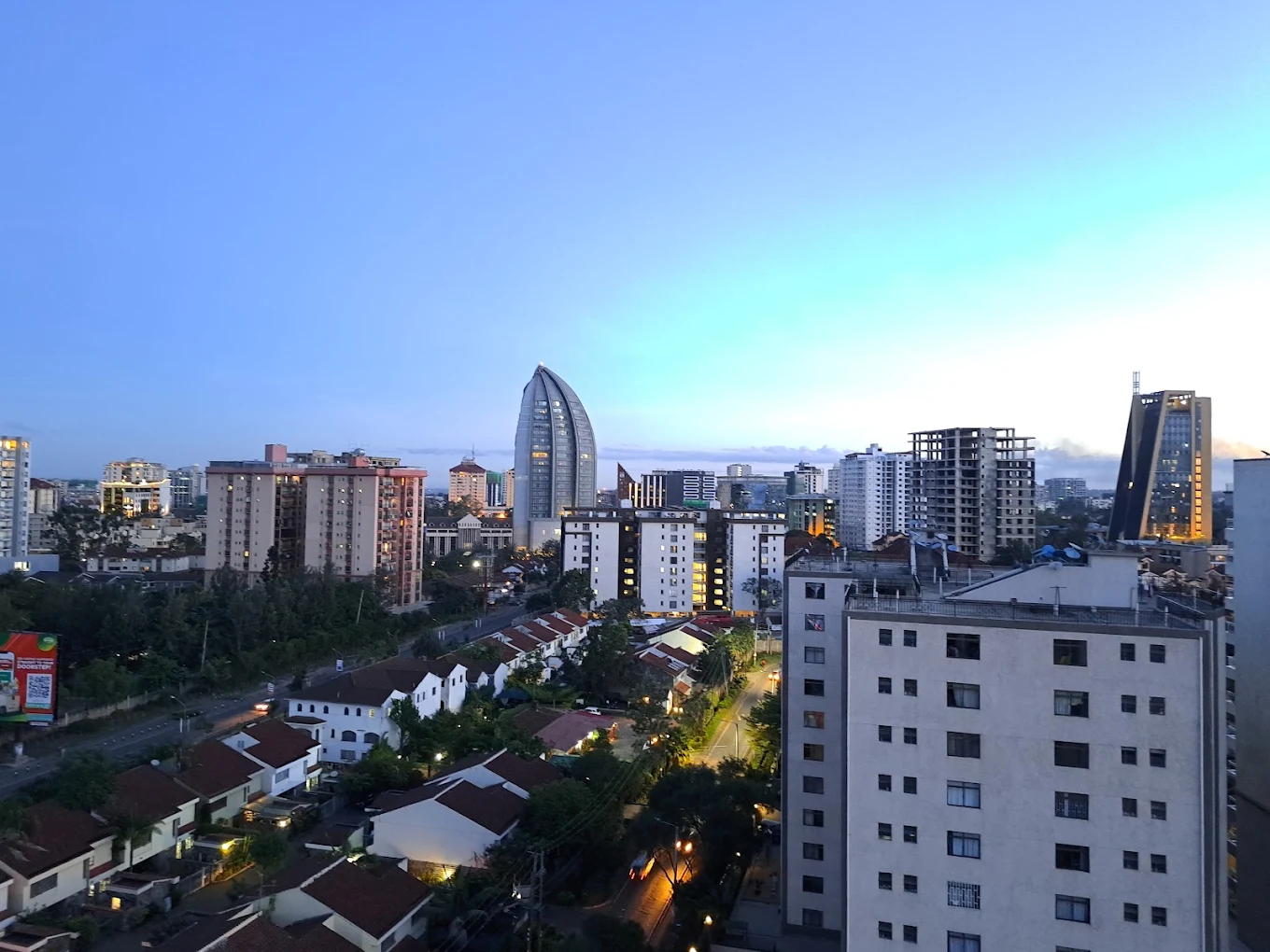
There are currently hundreds of apartments advertised for sale in Kilimani on Cheru alone, with an average asking price of about KSh11.5 million. That is one portal, on one day, in one neighbourhood. It does not capture every developer, every private sale, every agent mandate or every project still under construction.
The visible pipeline is just as striking.
Nova Garden Apartments, for example, is marketing one, two and three-bedroom units for completion in December 2028. Another current project, Golden Apple, is marketed as a 587-unit development across two towers, with 23 and 24 floors respectively, and completion targeted for 2028. Capital Garden is another 17-floor Kilimani development with one, two and three-bedroom units, while Royal Legend Residence is selling two to five-bedroom apartments for completion later this year.
None of those projects, individually, proves oversupply.
Together, they illustrate the scale of what has happened to Kilimani.
A neighbourhood once dominated by low-rise apartments, maisonettes and detached homes has become one of Nairobi’s most concentrated high-rise residential development markets. Towers now compete street by street for essentially the same broad pool of buyers and tenants: professionals, small families, diaspora investors, short-stay operators and investors seeking rental income.
And that matters because Nairobi’s apartment market has already begun flashing warning signals.
Kenya National Bureau of Statistics data show that apartment prices nationally fell 3.0 percent in the year to March 2026. The apartment index declined from 91.5 in the first quarter of 2025 to 88.7 in the first quarter of 2026, and slipped another 0.2 percent quarter on quarter. By contrast, standalone house prices rose 8.5 percent over the same year.
KNBS’s longer series shows that the weakness did not suddenly appear this year. Its apartment index was 88.9 at the end of 2025, below its 2022 base, with upper and middle Nairobi showing particularly sustained pressure. KNBS specifically identifies weaker demand, changing buyer preferences and possible saturation in some urban apartment segments as factors behind the decline.
HassConsult has reached a similar conclusion from a different dataset.
In the year to March 2026, apartment prices fell in 10 of the 18 Nairobi suburbs and satellite markets it tracked. Westlands apartments fell 7.9 percent year on year, Upper Hill 6.8 percent, Lavington 6.4 percent, Ongata Rongai 5.5 percent and Ruaka 5.1 percent. HassConsult attributed the apartment correction to increased supply, saying some markets were moving towards saturation.
Kilimani is not currently the worst-performing apartment market in those numbers.
That distinction is important.
The latest HassConsult Q2 headline data actually show Kilimani’s overall residential property prices rising 0.9 percent in the quarter and 8.1 percent over the year. Those figures cover the broader residential category, not only apartments, and should therefore not be interpreted as evidence that every Kilimani apartment segment is appreciating.
At the same time, Kilimani rents softened slightly in Q2, with one published summary of the HassConsult index recording a 0.3 percent quarterly decline. That is hardly a collapse. But when a neighbourhood is simultaneously adding large amounts of supply, even small changes in rent deserve attention.
The deeper issue is not whether Kilimani has tenants.
It clearly does.
A separate Q2 2026 serviced-apartment survey covering 41 properties across Nairobi found Kilimani commanding the second-highest quoted rate per square metre among seven major submarkets, behind Gigiri. The report described Kilimani’s rates as broadly stable through the survey period.
The question is whether new supply is arriving faster than profitable demand is growing.
That distinction separates a busy property market from a healthy one.
One neighbourhood, many competing investors
Kilimani’s development economics have become unusually investor-driven.
Current off-plan projects repeatedly sell compact one and two-bedroom units with swimming pools, gyms, rooftops, fitted kitchens and payment plans stretching into 2027 or 2028.
Those features are attractive, but they also create a problem.
If hundreds of owners in neighbouring towers buy similar one-bedroom apartments for the same reason, expecting the same professional tenant or the same short-stay guest, they are not merely investors.
They are competitors.
When those buildings complete, every owner cannot simultaneously achieve the highest advertised rent, the highest occupancy and the developer’s strongest projected yield.
This is where buyers need to separate market demand from project marketing.
A neighbourhood can have strong overall rental demand and still contain individual buildings with too many identical units.
A landlord owning one of 20 two-bedroom apartments in a small established building competes differently from an owner of one unit in a 500-unit tower where dozens of landlords may put similar apartments onto the market at the same time.
That supply concentration creates pressure first through concessions rather than headline rent cuts.
Free months.
Negotiable deposits.
Included service charges.
Furniture packages.
Reduced short-stay rates.
Longer vacancy periods.
Eventually, weaker buildings may have to compete directly on rent.
Kilimani's land economics encourage density
There is also a structural reason the towers keep coming.
Land in Kilimani is expensive.
Cheru Estimate as of September 8, 2026 put Kilimani land at roughly KSh 382 million to 430 million per acre.
At that acquisition cost, developing a handful of large apartments makes little economic sense for many developers.
The land has to be spread across many saleable square metres.
That pushes projects upward and encourages smaller units that can reach a wider buyer pool.
A KSh6 million or KSh7 million one-bedroom can attract far more potential buyers than a KSh25 million family apartment.
The result is a logical development model for the individual developer.
But what is rational for each developer individually can eventually become difficult for the neighbourhood collectively.
Every new tower increases the amount of stock chasing the same tenant segments.
The apartment itself is no longer enough
For years, buyers in Kilimani could assume that a modern apartment in a good location would find a tenant.
That assumption now needs qualification.
In a market with hundreds of existing listings and substantial future supply, the difference between buildings becomes increasingly important.
Management quality matters.
Actual room sizes matter.
Water reliability matters.
Backup power matters.
Parking matters.
Service charges matter.
Noise matters.
Elevator waiting times matter.
Natural light matters.
And perhaps most importantly, the amount of competing inventory inside the same development matters.
A buyer considering a one-bedroom in a 500-unit development should ask how many of those units have the same layout and intended tenant.
They should ask how many are being sold to investors.
They should ask what competing projects will complete within a kilometre during the same year.
And they should treat projected rents as forecasts, not facts.
Is Kilimani oversupplied?
The evidence supports a more careful answer than either extreme.
Kilimani is not a dead apartment market. It remains central, heavily searched, well-connected and attractive to long-term and serviced-apartment tenants. Current rental evidence shows the neighbourhood still commands strong rates.
But Nairobi’s broader apartment market is already experiencing a supply-driven correction, official KNBS data show sustained apartment-price weakness, and Kilimani continues to add substantial new stock.
That makes the risk of micro-level oversupply very real.
The most vulnerable units are likely to be the ones easiest to substitute: small apartments in very large developments where neighbouring towers offer nearly identical products.
The strongest may prove to be harder-to-replace units: larger layouts, unusually good locations, established buildings with strong management, low service charges or properties with genuine scarcity.
That is a much less dramatic conclusion than saying Kilimani has built too much.
It is also more useful.
The neighbourhood does not have one apartment market anymore.
It has dozens of them stacked on top of each other.
And in 2026, buying in Kilimani means understanding which one you are entering.
Explore Kilimani
Continue reading