
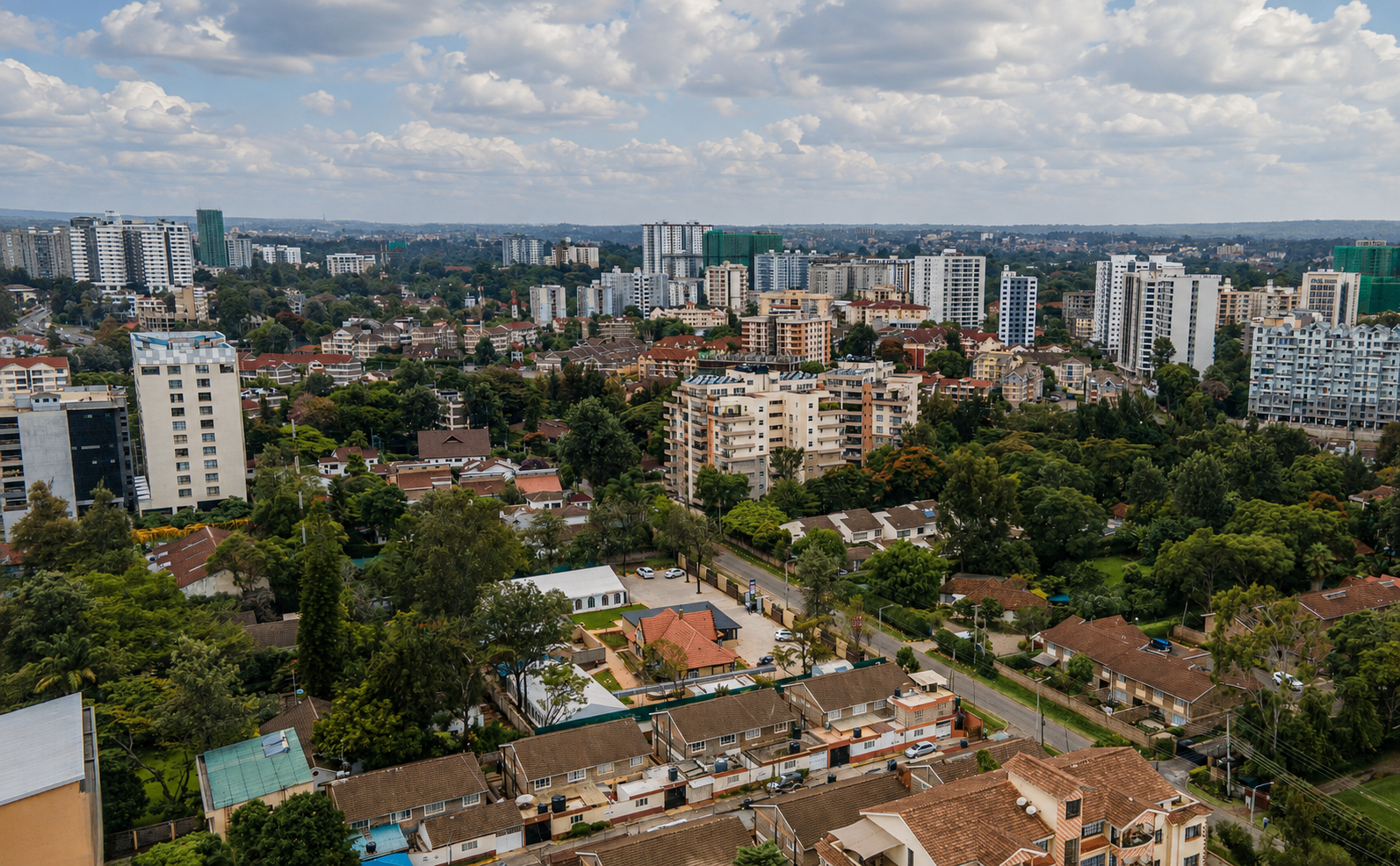
At KSh10 million, a buyer can still enter Nairobi’s apartment market, but the address now determines whether the money buys a compact one-bedroom, a conventional two-bedroom or a full family apartment.
KSh10 million sounds like a substantial housing budget until it is placed against Nairobi’s current property market.
The latest Q3 2026 asking-price data from Cheru Estimate puts the median asking price for all residential property in Nairobi at KSh21 million. Apartments are cheaper, but even there the median is KSh13 million. That means a buyer arriving with KSh10 million is not shopping in the middle of the Nairobi market. They are shopping below it.
What the money buys, however, changes dramatically over surprisingly short distances.
In Kilimani, KSh10 million has become an entry point rather than a generous budget. Kenya Property Centre’s current dataset places the median apartment asking price there at KSh11.9 million. Current listings show that sub-KSh10 million units still exist, including some developments where small one- and two-bedroom units start well below that level and occasional three-bedroom stock is advertised around KSh9 million. But those examples sit below the area median and need to be examined carefully for size, completion status, building density and exact location.
That distinction matters.
Kilimani is one of the clearest examples of how the Nairobi apartment market has split into multiple markets occupying the same postcode. One development may sell a compact investor-oriented one-bedroom for KSh5 million or KSh6 million, while another several streets away asks more than KSh20 million for a larger family apartment. A buyer should therefore be suspicious of any statement that “a two-bedroom in Kilimani costs X.” There is no single Kilimani apartment anymore.
Move west to Westlands and KSh10 million becomes tighter still.
The current median asking price for an apartment in the wider Westlands market is KSh13.5 million. At KSh10 million, a buyer is generally looking towards smaller one-bedroom stock, older buildings, off-plan entry units or projects away from the most expensive pockets. The budget can get a buyer into Westlands, but it does not buy the typical Westlands apartment represented by the current median.
The picture changes in places such as South B and South C, where KSh10 million can compete for two- and three-bedroom family apartments rather than merely securing an entry-level unit. Current Nairobi pricing guides place typical two-bedroom asking prices in these neighbourhoods around KSh6.5 million to KSh9 million, with three-bedroom stock commonly extending into the KSh8 million to KSh14 million range. Those figures are asking-price guides rather than recorded transaction prices, but they demonstrate how much additional internal space the same money can buy once the buyer leaves Nairobi’s most aggressively developed western apartment belt.
The contrast becomes even sharper outside Nairobi County.
In Syokimau, where the market is strongly tied to Mombasa Road, JKIA, the SGR and the Expressway corridor, the median apartment asking price in the current Q3 dataset is KSh8.5 million. KSh10 million therefore sits above the area’s median apartment price rather than below it.
Current Syokimau listings illustrates the difference. A three-bedroom apartment measuring 136 square metres is advertised at KSh9.9 million. While Cheru Estimate, puts it's estimated value at around 9.5M. Other projects are asking considerably more, particularly where units are larger or include a domestic staff quarter and extensive amenities, but the important point is what KSh10 million is competing for: in Syokimau, it can still be family-home money.
That same budget in Kilimani may buy a much smaller apartment.
This is the central trade-off facing Nairobi buyers in 2026.
The market increasingly makes buyers choose between address, space and property type. It is difficult to maximise all three with KSh10 million.
A buyer who prioritises proximity to Upper Hill, Westlands, the CBD and Nairobi’s established commercial centres can remain relatively central, but will generally sacrifice floor area or bedrooms. A buyer who prioritises three bedrooms, parking and more internal space will usually need to move farther from the city’s premium apartment districts. A buyer who insists on a standalone house faces an even tougher market.
Cheru's numbers put the median asking price for Nairobi houses at KSh99 million. That figure is heavily influenced by high-value suburban stock, but it makes the broader point: KSh10 million is overwhelmingly an apartment budget in established Nairobi.
Outside the county, the equation changes. In Machakos County, the current median residential asking price is KSh10 million, while apartments have a median of KSh8 million. In Athi River, the apartment median is just under KSh5 million, while houses are around KSh15 million.
So the decision cannot be reduced to “where can I afford?”
The better question is: what am I buying the property to do?
Someone buying for their own occupation may reasonably value an additional bedroom, shorter school run or larger kitchen more than a prestigious address. An investor may care more about tenant depth, achievable rent, service charge and how much competing stock is under construction. A buyer expecting to resell within three or four years should pay much closer attention to liquidity and the amount of similar inventory nearby.
And the asking price should never be treated as the entire purchase price.
A KSh10 million acquisition still attracts transaction expenses, including stamp duty, legal work, valuation and registration-related costs depending on the transaction and financing structure. A buyer spending their entire KSh10 million cash reserve on the advertised price may therefore already be over budget before the keys change hands.
There is another caution hidden inside the data: the numbers in current market reports are asking prices, not confirmed selling prices. Kenya Property Centre explicitly describes its figures as advertised asking prices, while its days-on-market data is drawn separately from transactions agents recorded as completed.
That means KSh10 million can occasionally reach a property advertised above KSh10 million if the seller negotiates. It can also be far too much for a poorly priced property advertised at exactly KSh10 million.
The number on the listing is the start of the valuation discussion, not the conclusion.
For Nairobi buyers in 2026, KSh10 million still has purchasing power. It can buy an apartment in Kilimani. It can put a buyer into parts of Westlands. It can buy more conventional family accommodation in older or less expensive Nairobi neighbourhoods, and it can stretch much further in Syokimau and other commuter markets.
What it no longer buys is freedom from compromise.
At this price, Nairobi is asking the buyer to choose what matters most: being closer, living larger or buying newer.
That choice may ultimately matter more than the neighbourhood name printed on the title.
Explore Nairobi
Reporting record
Sources
Continue reading
Related reporting
News · Residential